
 Posted by
 Our ultimate social media aim is to ensure our content reaches as many eyeballs as possible.
We gauge our success by relying on metrics like reach and impressions to measure our impact.
While closely related, these metrics help point out the factors affecting our social media growth the most, illuminating content visibility and engagement.
Capturing these subtle but powerful facets is important for brand exposure or influence content creation.
While reach and impressions may seem interchangeable at first glance, grasping their distinct definitions and implications is essential.
This article will explain the relationship between social media impressions and reach and the most influential marketing metric for a small business.
What is Reach?
Reach indicates the number of unique users exposed to a piece of content having that audience size as a potential market.
For instance, if your ad is displayed 500 times and 200 people click, your reach would be 200.
What are Impressions?

Conversely, impressions account for the total number of times social media content is seen by users, regardless of whether they interact with it. So, if your ad is displayed 500 times, your impressions would also be 500.
Unlike reach, impressions count every instance of the content being shown, including multiple views by the same user.
Reach vs Impressions: What’s the Difference?
There is a subtle but important difference between the two — not all platforms define them the same way.
- Reach measures how many people have seen your content
- Impressions measure how many times your content was viewed
Take a look at this table to understand the difference better —

Certain social media management tools help boost your reach and impressions on social media. One such tool that holds immense potential in enhancing both impressions and reach is text to speech online (TTS) technology. By incorporating TTS capabilities into your content strategy, you can cater to diverse audience preferences and accessibility needs.
Whether transforming written posts into engaging audio clips or providing audio descriptions for visually impaired users, TTS offers a versatile solution for maximizing content engagement and inclusivity.
Facebook Reach vs. Impressions
Facebook is the leading social commerce platform, with over 63.5 million people making at least one purchase from the platform. As a small business, marketing your business on Facebook via paid or organic content is your best bet.
Let’s understand what Facebook reach and impressions mean.
Understanding Facebook Reach
A Facebook page’s reach indicates how many people saw content associated with the page (for example, a post you were tagged in).

Facebook categorizes reach into three main types:
- Organic Reach: The number of people who saw your content without paid promotion.
- Paid Reach: The number of people who saw your content as a result of paid advertising efforts, such as Facebook Ads.
- Viral Reach: The number of people who saw your content because it was shared or mentioned by others, such as through likes, shares, or comments.
Understanding Facebook Impressions
Impressions refer to the number of times content from or about your page enters someone’s screen. This could be in their news feed, through search, or because they intentionally navigated to your Page.
Similar to reach, Facebook breaks down impressions into three main categories:
- Organic Impressions: The total number of times your content was displayed in a user’s news feed or on your Page without any paid promotion.
- Paid Impressions: The number of times your paid content, such as Facebook Ads, was displayed to users.
- Viral Impressions: The total number of times another user published content associated with your page, such as through likes, shares, or comments.
Also read: Mastering Facebook Marketing for Real Estate: Your Comprehensive Guide
Instagram Reach vs. Impressions
If you’re talking about Facebook, then Instagram makes an entry too. This meta-based platform saw a whopping 12.2% year-over-year increase in ad reach.
Let’s take a look at how Instagram reach and impressions work.
Understanding Instagram Reach
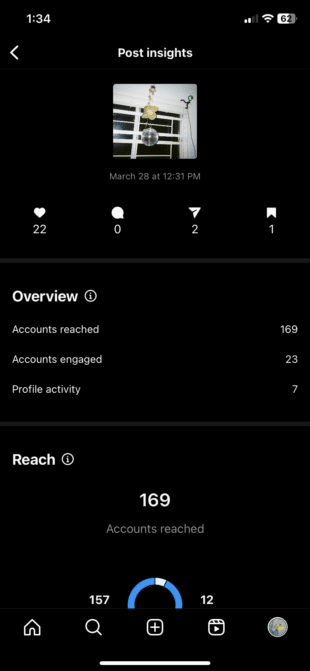
Accounts Reached refers to how many unique accounts have seen your content on Instagram at least once.
Instagram provides insights into reach over various timeframes and demographics, allowing you to understand the breadth of your content’s audience and the effectiveness of your targeting efforts.
Understanding Instagram Impressions
Instagram offers insights into Impressions broken down by source, including hashtags, home feed, profile visits, explore page, and other sources. This breakdown helps you understand where users discover and consume your content.
You can view Instagram reach and impressions over the past 7 days, 30 days, the previous month, or 90 days. Additionally, you can break them down by demographics such as gender, age, and location.
Should your Small Business Focus on Reach or Impressions?
To understand if your small business should focus on reach or impressions, we need to look at them through different lenses.
When to Prioritize Impressions?
Impressions can be valuable if your primary aim is to create brand awareness and leave a lasting impact on your audience.
Focus on impressions when —
- Building Brand Recognition: Prioritizing impressions can help establish your brand presence and impact your audience.
- Immediate Performance Evaluation: By tracking impressions after posting, you can assess the effectiveness of your ads or posts in real-time. If your content receives low impressions, you can make timely adjustments to optimize its impact and avoid unnecessary costs.
- Assessing Effective Frequency: Monitoring impressions allows you to calculate the effective frequency of your content and helps you balance exposure and engagement.
When to Prioritize Reach?
Reach becomes essential when your primary focus is reaching a diverse audience and expanding your brand’s following.
Here’s when prioritizing Reach might be advantageous:
- Expanding Audience Reach: If your goal is to reach as many unique users as possible and attract new followers to your brand, prioritizing reach can help broaden your audience.
- Optimizing Paid Campaigns: A high reach indicates that your ads effectively reach your target audience, increasing the likelihood of engagement rates and conversions. It helps ensure that your ad spend is directed toward reaching the right users.
- Measuring Growth and Engagement: Tracking reach allows you to measure the growth of your social media presence and gauge audience engagement. As it increases, it indicates that your content strategy effectively attracts and engages users
Whether you focus on reach and impressions depends on your marketing goals. Start by focusing on one metric before doubling down on the others.
Conclusion
The main goal of having a social media presence is to maximize content visibility.
And we rely on metrics such as reach and impressions to gauge our success.
Though seemingly interchangeable, these metrics diverge in their insights, each focusing on a unique facet of our content’s impact.
Which of these two you focus on will depend on your goal. Choose wisely.