

 Posted by
 In this omnichannel era, many businesses see a presence on all social media platforms as essential for connecting with their target demographics. Marketers pay close attention to two demographic details; the ages (and genders) of their target audience and the target customers they want to reach and engage with.
One of the biggest social media platforms is Instagram which can be ideal for reaching people in the 18–34 age group. Just as with any other marketing tactics, it’s important to collect and analyze data and feedback in order to improve your offerings. How do you use Instagram reel insights so that you can improve your content strategy and attract more customers?
What are Instagram Reels?

Instagram reels are short videos that can be anything up to 90 seconds in length. Although the platform supports different content types, reels are the most popular with more than 2 billion monthly users and an average reach rate of 30.81%. Reels are most often shot in a vertical screen format that provides a better viewing experience.
Instagram sees Reels as a competitor for Tik Tok which appeals to a similar age demographic. Reels is fast becoming a focus of Instagram’s efforts and now has its own tab on the Instagram app and continuing evolution in format and presentation. Reels can be a great option for smaller businesses on a tight budget.
Instagram reels insights; what metrics matter?
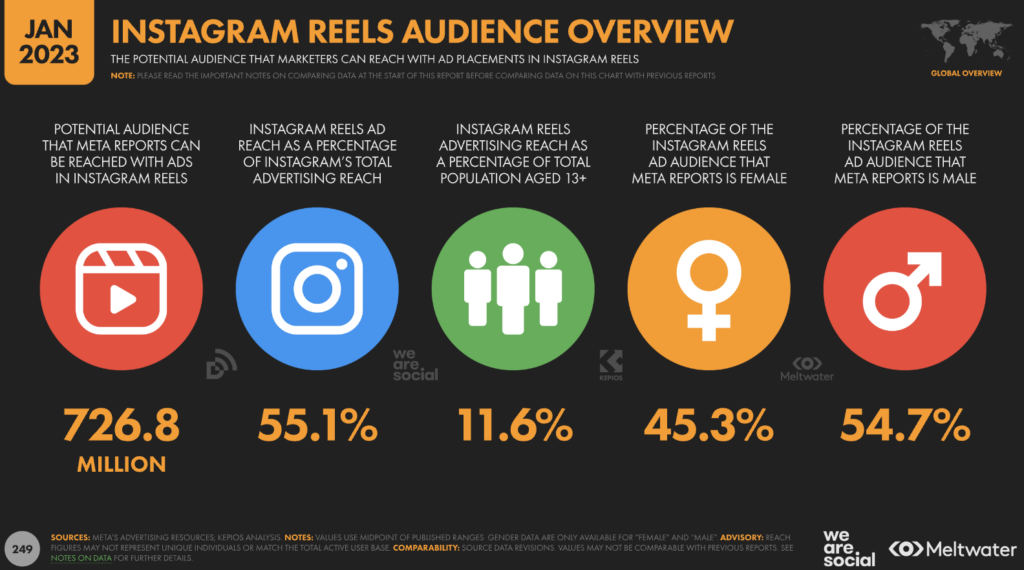
If you want insights into your Instagram performance, you need to be aware of what metrics are indicators of that performance. There are two areas you need to consider; reach and engagement. The metrics for each can help highlight any areas of your marketing plan or content strategy that need tweaking.
Reach metrics
Reach tells you details about the number of people who are seeing your video. There are two metrics to consider:
- Accounts. This refers to the number of Instagram accounts your posts have reached. These people have to have seen your reel at least once.
- Plays. This is the total number of plays your reel has had. This figure can differ from the accounts reached as — if your reel is engaging enough — people may have viewed your reel more than once.
Engagement metrics

People may have seen your Reel but to what level, if any, did they actually engage with it?
- Comments. Did people think your reel was good — or bad — enough to leave a comment?
- Likes. This can be a useful metric as it can show your content is working.
- Saves. Viewers may decide to bookmark your reel, either to show someone or to view it again.
- Shares. This is a valuable metric as it counts how often people have shared your reel, thus extending its reach.
Where will you find your Instagram insights?
So, now you know what metrics you need to be looking at, where will you find insights that you can act on? On your mobile app, your profile page has a button marked ‘insights’. Personal accounts won’t have this so ensure any profile you have is a professional one (creator or business account).
The overview section has a sub-section labeled ‘accounts reached’. This contains the insights and data you want. Your analytics are contained in the reach breakdown so you can see how your reels are performing. You only want to see analytics that are relevant to your reels so look at the Reels section on the insights overview screen.
To see how individual Reels are performing, essential if you want to improve your performance and content, open the reel you want data on, tape the three dots in the bottom right hand of your screen, then tap on insights.
Using analytics to improve your content and performance

Ok, so you know what metrics to look at and you know where to find them. How do you use those analytics to make informed and data-driven decisions that can improve the content you post in Reels?
1. Styles
Your engagement rate can tell you a story but it’s not always a good story. You should be taking close attention to both positive and negative comments on your Reels. Positive comments may validate certain elements of your style and negative comments can highlight things you’ve got wrong.
Another thing that can help you with the style of your Reels is to look at other ones, especially ones that have high engagement. You can start by looking at competitors’ Reels (or similar brands). What are they doing that is different from your Reels? What stands out and what are people saying about their Reels? Employing insights from highly engaging content is a strategic way to boost Instagram engagement.
In analyzing the style of your Reels, consider not only the content but also the quality of the editing. Employing a sophisticated video editor allows you to refine your videos with precision, enhancing visual appeal and overall impact.
Combining the analytics from your insights with seeing what other Reels get right can put you on the path to a winning formula.
2. Length of Reels
Just because you can do something doesn’t mean you should. Given that an American’s average attention span when watching a video is 8.25 seconds (that’s less than a goldfish!), then you may not want to use Instagram’s 90-second limit. Again, look at what others are doing successfully and adjust your own lengths.
Think about the goal of each video and how much time it could take to achieve that goal. If you can get your message across in 30 seconds or less, then make your Instagram Reels that length. There’s little point in adding superfluous content just because it looks nice.
3. Soundtrack
As with styles, use your insights to see what options work best. It may be the case that you will use different audio tracks for different Reels; it can all depend on each video you want to post. Instagram offers different options so see what works well for you.
- Narration/voiceover. Can be good if you want to convey extra information or instill a sense of urgency with your CTA (call to action).
- Original audio. It may be the case that the audio that came with the video clip works best such as with a product demo.
- Music. You may want the video itself to convey the message and just add music on top. Just be careful that any music you use is not copyrighted or your soundtrack could be muted.
- AI. Many platforms — including Instagram — now offer text-to-speech generators. The problem with these, as it usually happens with all types of generative AI, is they can sometimes sound very artificial.
- Subtitles. Including captions on your video not only ensures accessibility, they can also help get your message across.
Utilizing rich media options such as dynamic visual effects, interactive elements, and varied audio, including music, can significantly enhance viewer engagement.
4. Times
One thing to look at in your analytics is the different times (and even days) you posted and how that Reel performed. There are various suggestions as to optimum times to post include early mornings and lunchtimes.
However, it’s worth remembering that what works for others may not be ideal for you, so while these guides can be useful in the beginning, use your analytics to identify engagement patterns for your Reels. Those patterns can tell you the times that your target demographics are most likely to see — and engage with — your Reels.
Why your analytics matter
Without analytics, your marketing teams would be stumbling around in the dark. As with your other social media strategy and marketing efforts, using analytics is like turning on a light in that dark room.
Content marketing statistics also play a crucial role in shaping strategic decisions, offering insights into broader trends and effectiveness that can be applied to enhance Instagram Reels engagement.
Your marketing experts may not get it right the first time (though close to would be nice) but analytics can help them tweak things to reach a wider audience.
By paying close attention to your Instagram Reels analytics, your team can learn as they go and can gain insights into the following that enable informed decisions.
- Audience tastes. What does your target audience like or dislike? For example, do they want to play fun and easy games or do they prefer more serious content?
- Times. Your analytics will show what days and what times your audience is most likely to see and engage with your Reels B2B customers are likely to have different viewing patterns from B2C consumers.
- Soundtrack. Does your audience prefer music, narration, or both?
- CTAs. What CTAs in your Instagram Reels have led to the most conversions? How you word and place your CTAs can have a big impact on their effectiveness.
- Effects and filters. Which performs best, your Reels that are ‘natural’ or the ones that you’ve added lots of effects and filters to?
The thing all your analytical insights have in common is ‘patterns’. When you see that a particular Reel format or posting time is working well, then you should be looking to replicate any pattern across all your Instagram Reels.
Equally, if a Reel (or Reels) is performing badly, then ask yourself why and see if you can eliminate what’s causing it. Using machine learning model types can help to find those patterns and make decisions accordingly.
The Takeaway

Social media marketing can be a great strategy, especially when a business doesn’t have an enterprise-level budget. Within social media, telling a story or conveying a message via video is an effective tactic and Instagram Reels is proving strong competition to TikTok.
As with any of your marketing efforts, you want to know what works and what doesn’t so you can improve performance.
Instagram Reels insights let you see the analytics of Reels you have posted. By using these analytics — and looking at what your competitors are doing right — you can tweak your efforts so that the metrics improve.