

 Posted by
 Social media powers our modern society. We subconsciously turn to social media when we wake up and linger for too long before going to bed.
The average person spends over two hours on social media every day — that’s 12.5% of your waking hours (assuming you get eight hours of sleep).
So, it’s no wonder brands prioritize building a strong social media presence. That said, a few royal screw-ups are bound to happen, some with ill intentions and others by pure accident.
You may also see a crisis with your product/service or business environment, and in that time, social media can also become a powerful tool for crisis management.
Here are a few real-life examples of crises playing out on social media:
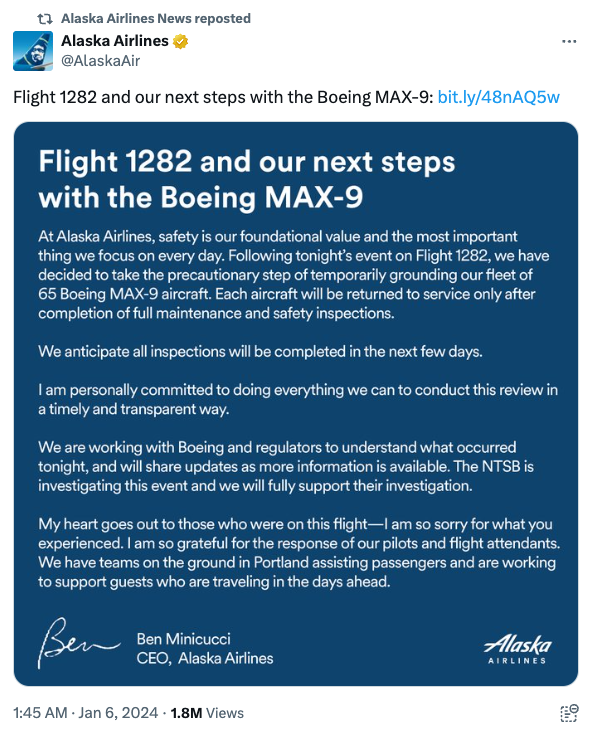
- A door plug “blew off” after Alaska Airlines Flight 1282 took off from Portland International Airport, leaving a large hole in the side of the plane.
People captured this horrifying moment and posted it all over social media. To remediate the issue, the CEO then took to social media to make a public apology.
While we hope a crisis-like situation doesn’t happen for you or your customers, it’s still worthwhile to mention that businesses make errors in small ways in their daily operations (e.g., product malfunctions).
In times like these, you should be ready to make amends with your customers and have a crisis management plan. On that note, let’s dig in to find the top seven tips and best practices you should keep in mind when handling a crisis on social media.
1. Be empathetic
First things first — always keep an empathic tone. Try to understand where your customers and their complaints are coming from, and then try to create an apology that addresses their problems and provides a solution.
Avoid using a defensive tone or making excuses. If you make a mistake, you must own up to it. Doing so will allow customers to see that you’re a company run by people. As it happens, people make mistakes.
Here are a few pointers to consider when writing your apology:
- Try to be as transparent about the situation as possible (e.g., if you’ve come under flack for a product malfunction, explain why that happened and what you’ll do to avoid the mistake later down the line).
- Always use the word “sorry” and avoid ifs and buts. You don’t want to make a non-apology.
- Don’t use formal words or corporate jargon. Instead, opt for a warm, friendly tone.
- Don’t try to shift the blame
2. Respond promptly
Next up, you need to ensure you’re prompt with your apology. In this day and age, you can rely on AI tools like email subject line generator to help you brainstorm ideas on how to create the most effective message quickly.
This is paramount because
the apology should be out tomorrow if a crisis happens today. You can’t wait for the crisis to go into yesteryear — it’ll ruin your company’s goodwill and impact your reputation and relationships with your employees and customers.
On that note, one best practice to consider is to stop all scheduled and unscheduled social media marketing posts until you’ve published your apology. Another best practice in this context is to reply to comments with negative mentions or complaints.
For example, you can leverage social media listening tools to find brand mentions. If customers have complained about your product/service, you can respond individually to each complaint to provide them with a solution or a course of action.
Just a quick note: Replying to negative comments about your product/service is a best practice in general, and many brands adopt this practice to maintain good relationships with their customers.

3. Create a crisis plan
If the severity of your crisis is at an all-time high, you’ll need to create a crisis plan that will indicate how you’ll respond.

In most instances, even before any crises arise, companies might already have a crisis management plan on hand that’d be developed with the help of their PR teams.
However, if you’re creating a plan for the first time, you’ll need the help of your key stakeholders (e.g., your customer-facing teams, PR department, and C-level executives) to identify:
- What course of corrective actions would you like to proceed with?
- What are the common customer complaints?
- How you want to structure your apology
- Which channels you like to target
- What will the execution look like
Once this plan is set, you’ll need company-wide employee training — especially your client-facing teams such as sales and customer support.
In this training, provide them with the context of the issue, show real customer complaints, and tell them the plan of action they should take when talking to customers to alleviate the issue.
You’ll also need to revisit this plan to see if it’s managing to achieve the goal you want it to or if customers are still unhappy with your company.
4. Keep the same script on all channels
Here’s another best practice experts suggest taking: Keep the same script on all channels.
For example, suppose you’ve come across a serious issue, and you’re receiving customer complaints from everywhere (including online and offline channels). In that case, it doesn’t make sense to target only one social media channel (e.g., X) to apologize and tell your audience of the changes you’re planning to undertake.
Explain the issue on all channels, social media or otherwise. In some instances, companies that have been under a social media crisis have:
- Told stakeholders about their crisis plan of action in quarterly and end-of-year reports
- Educated client-facing teams on how to approach complaints about the crisis
- Developed new content assets that show customers how to alleviate issues
- Sent out company-wide emails explaining the issues to their employees
- Written public apologies on multiple social media channels
- Issued a public apology on their company’s website
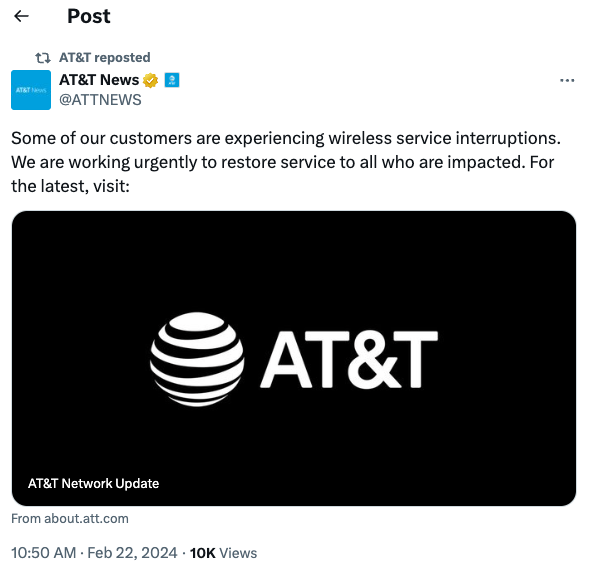
For example, AT&T customers woke up to cellular service outages in the early morning hours of February 22, 2024.
AT&T quickly crafted a dedicated landing page on its website to help customers check the status of the service outage.

AT&T also directed users from X (formerly Twitter) to this landing page to find the most recent updates.
5. Check your reputation score
Some folks also recommend keeping an eye out on your company’s reputation score to see if your reputation has shifted after the incident. Does it return to normal after your apology and crisis plan of action?
If not, we’d recommend getting in touch with trusted social media influencers who can turn the image of your brand.
6. Keep your audience updated
Another thing to keep in mind is to always inform and update your audience about the progress you’re making. This is especially necessary when you’re dealing with a situation that has large-scale, real-life implications.
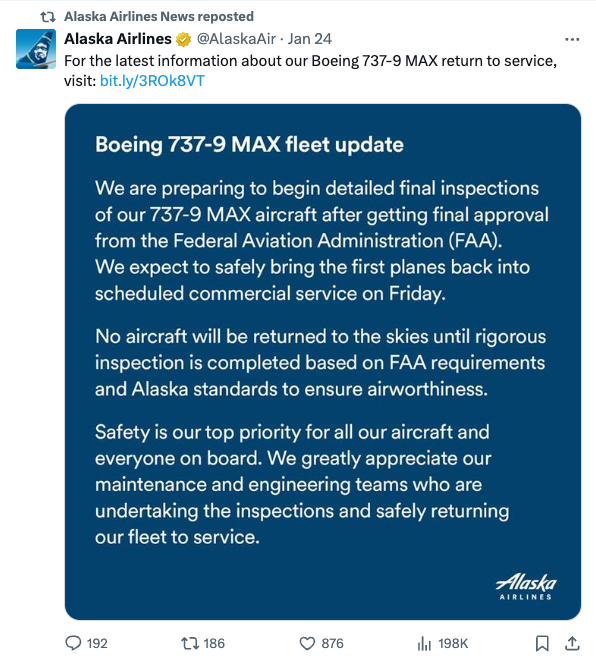
For example, Alaska Airlines continues to deliver updates via social media to inform the worried public about the actions the company is taking to ensure their safety during future flights.
However, for crises with a lower impact, like product malfunctions, if you’ve assured your audience that you’ll solve an XYZ issue by an XYZ date, you still need to keep providing progress reports until the deadline, when you show your final result.
Or, in such instances, once the issue has been resolved, try getting in touch with all the customers who raised complaints to see if they received a satisfactory experience, and then update your audience to inform them about the results of your efforts.
7. Learn from your mistakes
Last but not least, acknowledge that mistakes happen, but also try your best to learn from these mistakes so you don’t end up repeating them once again.
Encourage your social team to create a social media policy for distribution among team members. That way, everyone will be on the same page.
Trust us, having a crisis communication plan is worth the extra effort.
Improve your social media communication with the Crowdfire blog
And there you have it — tried-and-tested tips for social media crisis management.
If you’ve found our tips, tricks, and best practices about social media crisis communication interesting and helpful, you’ll be happy to learn that the Crowdfire blog has more such tips and tricks.
Our goal? Help you improve your social media presence by allowing you to communicate better with your audience across all social media platforms.
So, make sure your social media team stays in the loop about all the latest trends to avoid potential crises and create a robust action plan (read: crisis management strategy) to monitor your social media accounts and understand your social media users.
Also, if you’d like some help managing your customer communications, we’re here to help.
You can discover, schedule, and manage content for all your social media channels directly from Crowdfire.
Sign up for a 14-day free trial of Crowdfire, and/or check out our blog to keep up with topics of interest to you!